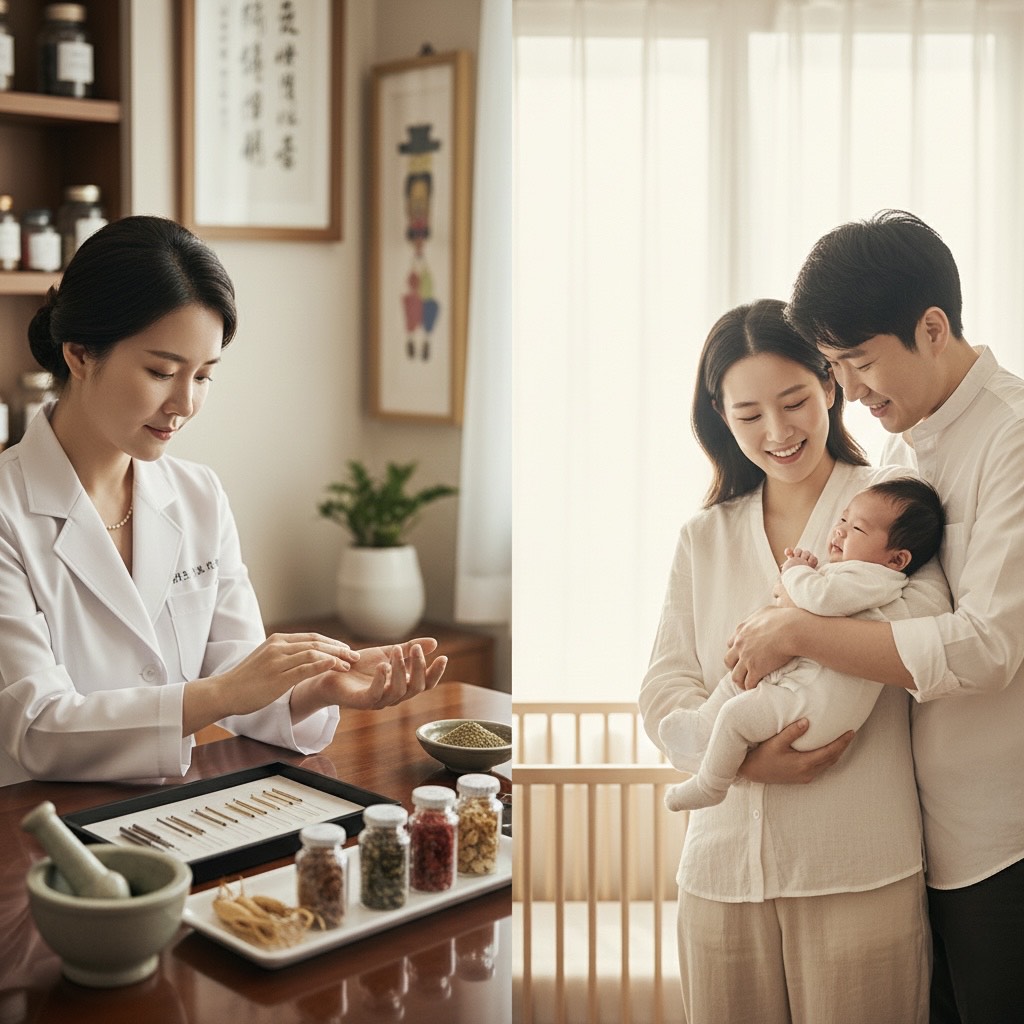
Introduction: Facing the Fertility Journey
Experiencing difficulty conceiving can be one of the most challenging times in a couple’s life. While Western medicine offers advanced solutions like IUI and IVF, many are seeking a holistic, systemic approach to enhance their chances. This is where Traditional Korean Medicine (TKM)—a medical tradition that integrates acupuncture, herbal medicine, and lifestyle guidance—offers powerful support.
The Role of TKM in Enhancing Female Fertility
TKM focuses on treating the underlying imbalances in the body to create a fertile environment. It views fertility as a reflection of overall health, emphasizing harmony within key systems like the kidneys, liver, and spleen.
1. Evidence-Based Support: Doubling Conception Rates
An extensive meta-analysis of 40 randomized controlled trials (RCTs) involving over 4,200 women suggests that Korean Herbal Medicine (KHM), administered according to TKM principles, can be highly effective:
- Higher Pregnancy Rates: Management of female infertility with Herbal Medicine can nearly double pregnancy rates compared to Western medical fertility drug therapy alone over a 3–6 month period.
- The average pregnancy rate in the Herbal Medicine group was 60%, compared to 33% in the Western medical (WM) group.
- Diverse Conditions: This benefit was observed across women dealing with common challenges such as Polycystic Ovary Syndrome (PCOS), anovulation (lack of ovulation), endometriosis, fallopian tube blockage, and unexplained infertility.
2. Optimizing the Body for Conception
TKM doesn’t just treat symptoms; it helps create the optimal biological conditions for a successful pregnancy, preparing the body at a foundational level. Studies show that Herbal Medicine positively influences several key fertility indicators:
- Ovulation: In women with previously anovulatory cycles, Herbal Medicine was associated with an 18% increased chance of improved ovulation compared to standard WM therapy.
- Uterine Environment: Treatment works to improve the thickness of the endometrial lining (to more than 6mm), which is critical for implantation, and helps re-establish a biphasic basal body temperature.
- Targeting Root Causes: Practitioners diagnose and treat deep-rooted issues—such as Blood stasis, Spleen Qi deficiency, or Kidney Jing deficiency—that may be hindering conception.
3. Supporting Assisted Reproductive Technology (ART)
TKM is an ideal complementary therapy for those undergoing treatments like IVF or IUI.
- Maximizing IVF Success: Research indicates that when Herbal Medicine is used as an adjunct therapy to IVF, it can increase the likelihood of clinical pregnancy two-fold.
- Safety and Efficacy: Combined TKM treatments (Herbal Medicine + Acupuncture) are generally safe and effective, and may reduce the risk of adverse side effects compared to Western medication alone.
- Emotional Support: Acupuncture can help reduce the stress and anxiety that often accompany fertility treatments, thereby supporting the body’s overall balance and blood flow.
The Acupia Approach: Personalized Fertility Care
TKM is a highly personalized form of treatment based on the individual’s underlying diagnosis. When you visit Acupia for fertility support, your treatment plan is based on a meticulous diagnosis.
- The Diagnosis: Your practitioner will assess your specific TKM pattern diagnosis —observing characteristics of your pulse, tongue, and most importantly, your detailed menstrual cycle history.
- The Treatment Protocol: Treatment involves a combination of:
- Personalized Herbal Formulas: Specific herbal mixtures, often containing 10–15 herbs, are prescribed to resolve imbalances like phlegm, dampness, or stagnation. Formulas may be adjusted based on the phases of your menstrual cycle.
- Acupuncture: Used to regulate the flow of Qi (vital energy), enhance circulation, and support the function of reproductive organs.
- Lifestyle Guidance: You will receive advice on diet and lifestyle, often focusing on foods and habits that strengthen the vital energy (Kidney Jing) essential for reproductive health.
Conclusion: A Holistic Path Forward
The journey to conception can be complex. By integrating the systemic balance offered by Traditional Korean Medicine—combining evidence-based herbal medicine and acupuncture—you take a powerful, holistic step toward optimizing your body for a stable, viable pregnancy and live birth